
What's Arising?
Blogs & Podcasts
Reflections, conversations, and explorations on the journey toward wholeness.
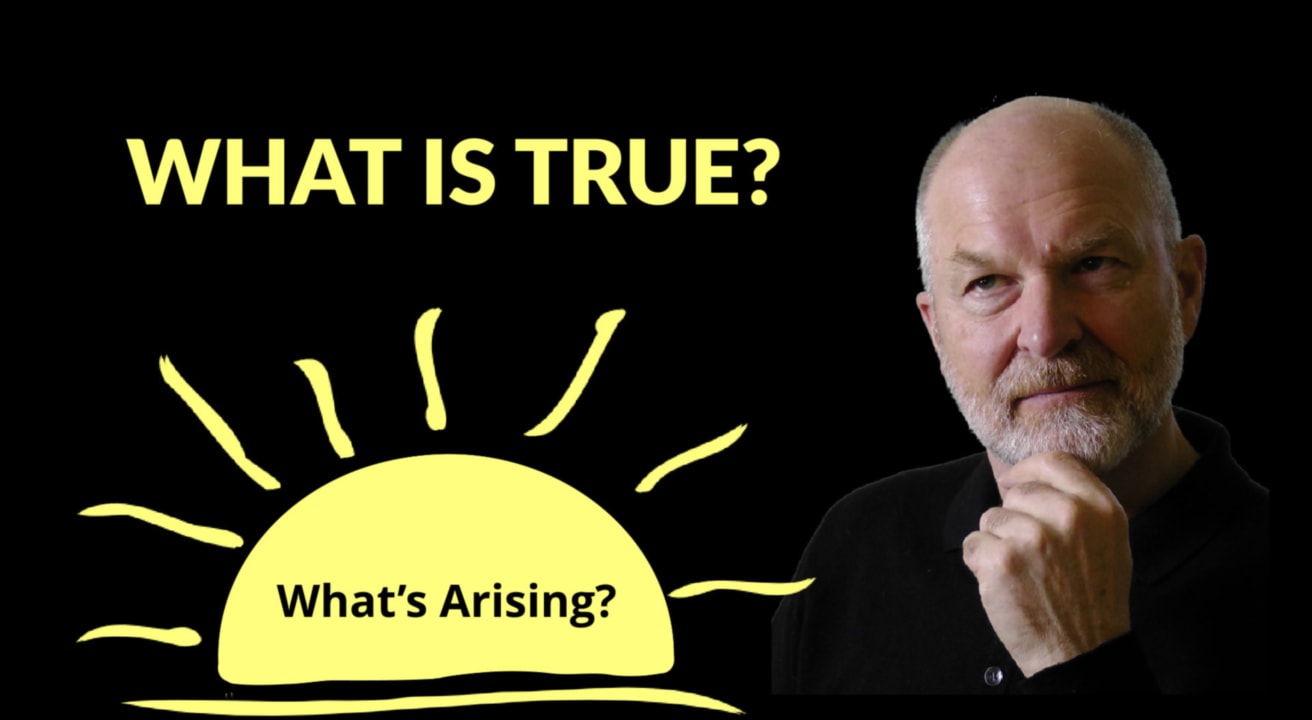
What is true?
... Episode 14 of the What's Arising Podcast
In this podcast, I explore the practice of asking, “What is true?” or “Is this true?”
In the coming years, this may be one of the most important questions to ask yourself. We already live in a world where it is difficult to know what is true. Misinformation, fake news, propaganda, censorship, and other corruption will only expand in the era of AI, so the truth will get harder and harder to detect.
Getting good at discerning ‘what’s true” starts with becoming aware of and letting go of the conditioning of our own mind. We need to be acutely aware of the stories and unknown lies we are telling ourselves. Asking 'What is true?" or “Is this true” helps us cut through all the illusions – the stories, meanings, beliefs, assumptions, judgments, and opinions that arise out of the mind and hold us in lies and falsehoods.
Links for items discussed in this podcast:
Shadow Integration Work can help you uncover and correct false beliefs and assumptions in your own mind.
Transcript
Welcome to What’s Arising?
It is such a pleasure to do these podcasts, to notice what is arising within me from week to week, and then to find an avenue to share that with whoever might show up.
I am listening to the invitation within myself in terms of what is arising, and I am inviting you to explore what is arising within you, within the world, and within the relationships you are in.
Hopefully, through this exploration of what is arising, we can come into more love and peace with ourselves, and gain some insight into what is emerging.
The topic today is an extension of “what’s arising,” and the question is:
What is true?
Or perhaps:
Is this true?
Whatever is arising, what is true here?
If something arises within us, we can ask, “Is this true?”
If someone from the outside world says something, we can ask, “What is true here?” or “Is that true?” Then we can begin to discern for ourselves.
This feels especially important in this age of misinformation, propaganda, and censorship. Of course, those things have always existed, but it can be hard to know what to trust. It can be hard to find people or circles where we can truly trust that others are questioning what is true before they share something, and where we can discern together.
So I want to take a deeper dive into this topic because we are living in a world of distrust, misinformation, and disinformation. This will likely become even more challenging through the capabilities of AI.
Discerning what is true is of ultimate importance.
Part of that discernment is learning to discern story, which I will talk about later.
Before I get into that, I want to invite you, as always, into the space of reflecting on what is arising for you internally. Notice what comes in the form of images, senses, feelings, thoughts, or sensations.
Get connected and present with yourself.
Notice what is arising from outside the world as well. Notice what comes toward you. Notice what carries a charge. Notice what may be fuel for further investigation.
Maybe this podcast on “What is true?” will help you focus in on something that is arising and disturbing you.
I invite you to become present with three rings of my bowl.
[Music / Singing Bowl]
A few weeks ago, a friend of mine and I were talking about open questions to explore. We dipped into the energy behind questions like:
What’s arising?
Or:
What are you noticing?
Or:
What’s here?
These questions bring us into the present moment.
There is something in the phrase “what’s arising” that carries a sense of emergence, becoming, and movement. I think that is why I chose it as the title of this podcast. It invites us to notice what is coming up within us — our thoughts, feelings, sensations, images — and also what is arising in the outer world.
What is bombarding us from the news, relationships, or life events? What is arriving in the present moment that we can focus on, be curious about, or perhaps let go?
“What’s arising?” is an opportunity to drop into something that is emerging.
I think it is a powerful awareness question. It is similar to “What are you noticing?” or “What’s here?” The question can be broad, or it can help us zoom in and explore something specific.
But there is a secondary question that I have been exploring:
What is true?
Or:
Is this true?
There is a sense for me that if something is arising in my awareness, there is some realness to it. Another useful question might be:
What is real?
Or:
Is this real?
Something might arise for me that no one else sees. Others might even consider it an illusion. It could be a vision, a sensation, or an image that comes in. It may not be real or true for someone else, but if it arises in my awareness, there is a kind of trueness to the fact that it arose.
There is ground there.
It is true that it arose.
The challenge and the opportunity is to notice the story we create around what is arising.
The mind tends to create a story about what is there. Something arises, and almost immediately the mind has a story. That story may go back to childhood, trauma, beliefs, past experiences, conditioning, and old patterns. The mind folds the present moment into that existing story.
Someone says something, and we may totally agree because it fits our story. Or we may revolt against it because it clashes with our story. The mind is constantly making meaning out of what is arising.
In many ways, story is a kind of fantasy. It is not necessarily reality itself. It is a story we have made up about reality.
So the invitation is to question the story that the mind is making up.
When we look closely, almost everything in our lives is story. Since childhood, we have been bombarded and conditioned with stories about the way things are and the way things should be. We have largely accepted those stories, or we have revolted against them and created our own counter-stories.
Then we get into patterns.
If we are looking at external narratives — from media, alternative media, communities, or groups we belong to — we are also looking at story. We may be in a group where everyone shares similar values and energy. That story may be useful and even beautiful, but it may not be entirely true.
Money itself is a story.
There is so much power in story.
As human beings, we are amazing storytellers. We create meaning out of almost everything. If we can imagine something, create a story about something we want to bring into the future, and live into that story, then it often seems to get created in our reality.
So story has creative power.
But story can also imprison us.
There is power in creating story, and there is imprisonment in getting caught in story.
Some stories lock us into a worldview. They involve belief systems, assumptions, shadows, and conditioned identities. They may come from trauma, hurt, pain, or separation from self.
They may express themselves as blame, judgment, opinion, and projection.
Our opinions, beliefs, and stories about others are often made up. They are not necessarily true. Or they may contain something true, but if we become rigidly convinced, we stop being curious.
Someone says a word, and we may immediately project a story onto them. Instead of asking, “When you said that word, what did you mean?” we assume we already know. We project our story onto them.
We may assume that when they did something, they intended to hurt us.
Maybe that is true.
But maybe not.
Maybe they simply said a word, and it rubbed against an old pattern or story from childhood. Then the mind and body react. We feel hurt. We feel angry. We create meaning.
Much of our reality, and our perception of reality, is locked into stories that block us, keep us stuck, and cause suffering.
So I invite you, as I invite myself, to become aware of the stories you have created in your life.
Become aware of the story in the moment when something is arising.
Ask:
Is this true?
Maybe the thing someone said is true in the sense that they really said it. Sometimes, of course, we misinterpret or mishear people. We may put words into someone’s mouth that they did not say. That too may be part of a deeper story or trauma.
We often see the world through our story and filter things according to our beliefs.
But even when someone actually says something, what is the story we put on top of it?
What do we assume about their intent?
Intent is often another story.
If we can open as individuals and look at the story, we can ask:
What is true here?
Is my story true?
We can also remember that the other person has a story. They have conditioning. They are coming from a story too.
So perhaps we can become curious and ask:
What is their story here?
What is their need behind that story?
What is their trauma?
What is their concern?
What is their fear?
They have a story, just as we have a story.
If we can let go of our story about their story, and even our story about our own story, then we can come into a much cleaner space. There is much more freedom and much more power there.
Then we can consciously create story for a purpose that is helpful and in service to humanity.
What if we could show up in the world with a childlike openness? No fixed story. No rigid belief. Just an open heart and open mind, exploring, discovering, connecting with life, and meeting the world with fascination and wonder.
What if we could show up in the present, in the now, without all the stories of the mind and past distorting what is alive right here?
That is hard to do.
It is a process.
It is a process I have been in, I suppose, for all my life. And even as I practice letting go of stories, I can see that my mind is probably creating new ones I am not aware of yet.
So when something is arising, especially if it carries a charge, we can ask:
What is arising?
Is this true?
What is true here?
Notice where there is opinion, judgment, projection onto others, or a story about yourself — perhaps a “not good enough” story.
Go a little deeper.
This is going to be such an important skill. It always has been, but it may become even more important in a world of propaganda, censorship, narrowing narratives, and algorithmic herding.
If you start looking at a story around a conspiracy theory, the algorithms may take you further down the rabbit hole. You may end up getting more of what you are interested in, and before long you may be caught in a story, a group, or a tribe.
As you look for belonging, you may slip into the paranoia of that story.
So whatever rabbit hole you go down, examine the story that is unfolding. Watch yourself.
Ask:
Is this true?
What am I accepting as true?
Rather than going down only one storyline, it is important to look at multiple perspectives.
Open your mind.
You might say, “They seem to have a story there.” Then explore it. Be curious about it without getting caught.
Ask:
Is this true?
If it seems to be true, you might say, “Great. This story may be useful for me right now.”
But hold it lightly.
Explore with an open mind and open heart. Notice the charge you have against that story, or this story, or another story. Try to get a more whole perspective before you move into conclusions.
The mind wants to conclude that this is true and that is false.
But what I have found is that there is often a little bit of truth in many stories. There is also a story within me that makes me think something is true because it resonates with my inner pattern.
That story in me might come from an openhearted place, or it might come from a shadow I am not aware of. If I attach myself to that story, I may be attaching to something that is not ultimately true. It feels true because something in me wants it to be true.
So I gravitate toward a storyline that may not be healthy or open.
Or perhaps it is healthy and useful for now.
The key is holding our stories lightly.
If we are creating stories, we can also move into the power of story and ask:
If this is the story out there, what is the new story?
With my heart, mind, energy, and purpose, how can I serve in the creation of a new story, a new myth, or a new unfolding for humanity?
What is my role in the new story?
How can I take responsibility for how I create and co-create in the story of life, in service to making the world a better place for all?
This practice involves emptying the mind of stories that are no longer useful, becoming aware of them, and then consciously creating new stories for humanity.
Humanity has been going down a certain path for a long time now, and perhaps moving even more deeply into a story of materialism and technology — a story that says happiness is found outside of us.
Is that story useful for you?
For how long?
For me, I do not think I can find lasting happiness out there. I can find some level of happiness through money, freedom, comfort, and certain external supports. Those things are useful in life.
But how much is enough?
At some point, we are invited to turn inward, create a new story within, and let go. We surrender and forgive the old stories we created, even the stories about happiness being somewhere outside of us.
Then we reconnect with ourselves and with a different story within.
In the coming year, I hope to look more deeply at the stories happening in the media, the news, world events, politics, wars, and other collective narratives. I want to use those stories as reflections of me and of us.
I want to examine the stories projected onto people out there, and the stories we project onto them. Then I want to bring that inquiry inside and ask:
What is happening for me personally?
What stories am I making up?
What are the alternative stories?
Can I bring compassion and empathy to what another person’s story might be?
What do they want to believe?
The charge and triggers that happen when we hear someone else’s story are often where the real opportunity is. When there is a charge, we know we may be caught in a story or drama.
“I am upset because of what they said.”
“I am angry because of what happened.”
That is low-hanging fruit for inquiry.
We can notice what we felt, then examine the story around why we are angry or upset. Then we can go deeper, not staying on the surface, but going to the root of the story.
Sometimes it is useful to recreate the story — to create a story based on forgiveness, love, and an open heart.
Sometimes it is useful to eliminate the story entirely.
That is what I hope to explore in upcoming podcasts: examining shadow in relation to world events. There may be other things that arise from time to time, and I want to remain open and free with what is emerging from week to week.
I hope you enjoy that and find insight as I look at stories and narratives and question whether they are true.
And as I speak in these podcasts, I invite you to ask:
Richard said this. Is that true?
Is that true for me?
What else is true?
How does what is arising in you relate to what is arising in me?
What is arising between us in that relationship or exchange?
There may be insight there.
Asking “What is true?” or “Is this true?” can happen on many levels.
I invite you always to go deeper, to challenge the misrepresentations of truth that are arising all the time, and to consciously choose your story.
That is it for now.
If you like these podcasts or find this one useful, please like, subscribe, comment, and share your stories.
What is true?
What is not true?
What is coming up and arising for you?
Share this podcast with others if you feel it would be useful.
I get joy simply from doing this, and from watching myself in the unfolding of these podcasts. Maybe in the future I will look back and say, “Ah, I said that. That was what was true for me then, but it is no longer true now.”
So what is true now?
What is true now?
This is an open invitation to step into any relationship you have and let go of the story. See everyone and everything with fresh eyes, an open loving heart, and an open mind.
Ask:
What is here?
Then play in the curiosity and wonder of life.
I will see you next time.

Topics Explored
Shadow Integration • Wholeness • Freedom • Dialogue • Relationships • Personal Growth • Consciousness • Community • Leadership • Human Development • Individual & Collective Shadow Patterns • Beliefs
Pathways toward inner freedom and wholeness.


© WisdomWays. All rights reserved.