
What's Arising?
Blogs & Podcasts
Reflections, conversations, and explorations on the journey toward wholeness.
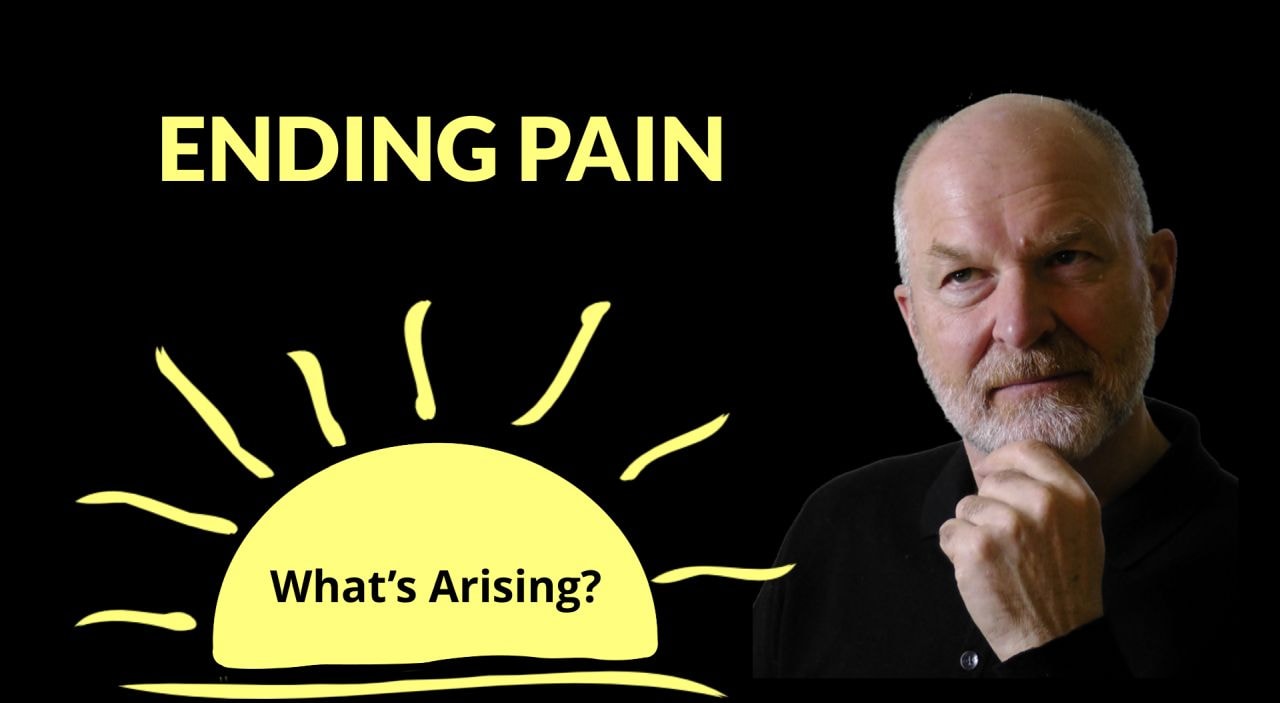
Ending Pain: Exploring the Deeper Roots of Physical, Emotional, Mental, and Spiritual Pain
... Episode 11 of What's Arising
What is pain? From where does it arise? How can you/we bring an end to pain?
Studies show that chronic pain (physical, emotional, mental and spiritual) is in increasing in our world. Around 20 percent of people in North America say they have chronic pain. 1 in 8 suffer from some kind of emotional/mental challenges including anxiety, loneliness and depression. Pain is at epidemic proportions.
In this What's Arising podcast, we'll explore pain from a metaphysical and holistic perspective. I'll tell some stories of personal experiences in healing physical and emotional pain. I'll also share some tips on how to discover the root causes of your pain, so that you can heal it or reduce its impact.
Links:
Shadow-work gets to the root of pain, healing the trauma, beliefs and story at the source. https://www.wisdomways.net/shadowintegration/
Emotional pain is associated with 'belonging'. You are invited to check out our Cohering Community project to learn about, experience and lead circles of belonging. https://www.coheringcommunity.com
Link to Lazaris's audio teaching on "Ending the Pain" that I mention in the podcast: https://www.lazaris.com/shop-product/healing-and-well-being/health-and-healing/ending-the-pain/
Transcript
Welcome once again to What’s Arising?
I am finding there is so much arising right now — in the world, in the groups I am part of, and in the experiences people are sharing. It is hard to pick one topic each week. I could probably pick several and get completely lost in what is arising.
But that is also the beauty of life: to notice what is arising.
I love contemplating these things, noticing the shifts, and sensing how life seems to be in ongoing conversation with us through the symbolism of our experience.
The topic I decided to focus on today is ending pain.
Thank you to the person who suggested I look at pain. I thought it was an interesting subject to contemplate and bring forward in a podcast, partly because pain is so prevalent in the world.
There is physical pain, including chronic pain, which seems to be increasing in North America. Many people live with pain that limits their ability to work, enjoy life, or feel free in their body.
There is also emotional pain: depression, anxiety, loneliness, and fear about the future. Many young people especially seem to be carrying a huge amount of anxiety around climate change, politics, social instability, and the conditions of the world.
There is also a crisis of meaning.
So what is all this pain about?
At some level, I suppose much of my work has always been about pain, though I usually think of it more as suffering. There is pain, and then there is the suffering we create around the pain.
Do we need to suffer in the same way?
What is the “secret sauce,” if there is one, to ending pain — or at least ending the suffering within the pain?
When I think of an animal in pain, I cannot know its inner experience, but I wonder if animals suffer in the same way human beings do. They feel pain, of course. But do they create all the extra story around the pain? Do they think about it in the same way? Or is there more simply an isness to it?
How do we return to that isness, even within pain?
And how do we begin to cope with, reduce, transform, or perhaps even release some of the pain we carry?
I want to share a couple of stories around pain from my own experience.
Personally, I have been blessed. I have not experienced much long-term physical pain. I have had some back pain at times. I once fell down stairs and tore a tendon in my shoulder, which was extremely painful. But these things did not last for a long time.
I do not really know the experience of chronic pain. I have not lived with intense pain day after day. I also have not taken painkillers for years, except briefly after that fall.
Some years ago, a man came to see me because he wanted to explore whether he could shift his pain. He had been experiencing pain throughout his body for several years. I cannot remember where it started, but it had spread everywhere.
He had become addicted to pain medication and eventually pulled himself out of that addiction, which showed tremendous determination. But he could not release the pain itself. Doctors had told him there was no clear physical reason for the pain and suggested it was mental or psychological.
He came to me at the suggestion of a friend and flew out to see me.
When he arrived, he was in extreme pain. If he moved, stood up, sat down, or even sat still, he felt pain throughout his body.
We worked together for about an hour or so, exploring different aspects of the pain. We began by helping him reduce the overall pain until he could sit and stand with no sense of pain. Then I asked him to try sitting down. As he moved into sitting, pain appeared, so we worked with that movement and the pain connected to it.
After about an hour or an hour and a half, his pain was gone. No matter how he moved, he felt no pain.
In that moment, it seemed like a success.
But later that afternoon, as he was getting on the plane, the pain began to return. It did not come back fully at first, but by the time he returned to his city, much of it had returned.
A few weeks later, he set up another appointment with me by phone. Again, after about an hour, the pain was gone.
This led me to wonder about deeper layers. Were there other beliefs or experiences we had not reached? Who would he be without the pain? What was his attachment to pain? Was there something else that needed to be found in order for him to release it more fully?
If the pain could be shifted through the mind or psyche, what would that mean for his story? Would it invalidate all the years of physical pain, doctors, medication, and suffering?
These are deeper questions. Sometimes pain has layers of meaning, identity, fear, protection, and story wrapped around it.
Another story comes from my sister, who passed away some years ago.
She was involved in a charismatic Christian church setting and had an unusual gift around sensing other people’s pain. She was paired with another woman from another church, and they would each receive pain in their own bodies.
One week it might be knee pain. Another week it might be back pain, headaches, or ear pain. They would call each other and say, “What are you feeling today?” If one had ear pain, the other might also have ear pain.
They understood themselves as intercessors for other people’s pain. They would pray together throughout the week, carrying the pain until it shifted. Then, miraculously, without the pastors knowing what they had been praying about, the pastor would call people forward in church for healing of that exact issue.
If ear pain had been the theme of the week, people with ear pain would be called forward.
What I noticed, though, was that my sister sometimes carried this pain for days. I later heard another healer describe a different way this could happen. He said he would feel just a nudge of pain — perhaps a small sensation in the knee — and that would let him know to call forward people with knee pain or mobility issues.
That is more how I tend to experience pain when working with people. I do not usually take it on intensely. But sometimes, when I am working with someone around beliefs, emotions, or shadow work, I may feel a sudden shot of pain in my head and think, “I never get headaches.” That may cue me to ask, “Do you have a headache?” And they may say, “Yes, I have a splitting headache.”
Then we may work with that before continuing.
This points to another important aspect of pain: empathic pain.
Some people are highly sensitive to the pain of others — emotionally, physically, mentally, or spiritually. We are part of a collective. We are not as separate as we think we are. If there is a lot of emotional pain in a room or group, some people may unconsciously pick that up and carry it.
So one useful question to ask around pain is:
Is this mine?
You might ask:
How much of this is mine?
You may be feeling pain at a nine out of ten level, and when you ask, “How much of this is mine?” you may sense that only a small portion is actually yours. If so, you can imagine sending the rest back to the collective, or back to wherever it came from, with love.
Sometimes you may choose to work with pain on behalf of the collective, but if you are inexperienced or overwhelmed, you do not necessarily need to carry it.
You can create a boundary.
I once worked with a client who was extremely open empathically. She would walk into a room and feel all kinds of things. It would disorient her.
I suggested that she imagine a dial. If she could feel something from someone else, she could imagine turning the dial down. She was very powerful with this. She could turn the sensation down until it was gone, then turn it up again and feel it.
The next time I saw her, she had created a whole inner console of dials, switches, and controls for different sensitivities — pain, emotion, and other empathic signals. She could adjust them instead of being overwhelmed by them.
So there are many ways we can explore pain, especially when it may not be entirely ours.
There can also be spiritual or energetic dimensions to pain. In a previous podcast on the sense of evil, I talked about a man in Africa who was experiencing deep mental anguish and depression. In that particular case, when we worked remotely, the anguish seemed connected to a spirit attachment. When that was addressed, his condition improved.
I do not want to reduce pain to one explanation. Pain can come from many layers: physical, emotional, mental, spiritual, energetic, relational, ancestral, or collective. The important question is:
What is this pain?
Where is it coming from?
What is it asking us to see?
There is a lot of capacity within us to reduce, transform, or release pain, though the path may be different for each person.
So let’s talk more about what pain is.
When I was asked to do this episode on ending pain, I remembered an audio teaching from a channel called Lazarus, channelled by Jach Pursel. Lazarus spoke about four kinds of pain:
physical pain, emotional pain, mental pain, and spiritual pain.
Physical pain is the sensation we know in the body.
Emotional pain may show up as anxiety, fear, loneliness, depression, sadness, grief, or emotional overwhelm.
Mental pain may show up as painful thoughts, painful images, obsessive thinking, or mental anguish.
Spiritual pain may show up as hollowness, emptiness, lack of meaning, or a sense of disconnection from God, Source, Spirit, or something larger than ourselves.
Lazarus suggested that many issues can be understood as either a separation from something or a longing for something. But pain, he suggested, is the synthesis of both: a separation from and a longing for something at the same time.
At the physical level, he described physical pain as a separation from and longing for control, and also a separation from and longing for feeling — the desire to know that we are alive.
Many people become numb in life. They trudge from day to day, disconnected from themselves and overwhelmed by experience. Sometimes pain may come in as a way to feel alive, to feel grounded, or to regain a sense of control in the physical world.
So with physical pain, one question might be:
Where am I feeling out of control?
What am I trying to control?
Where am I longing to feel more alive?
If pain is a symptom or a gateway, it may point us toward something underneath.
At the emotional level, Lazarus described emotional pain as a separation from and longing for belonging.
This feels very true to me.
So many people I meet carry a deep sense of not belonging. There is an epidemic of loneliness and disconnection. Community is not what it used to be. Many of us long for belonging, love, care, and the experience of being seen and held.
In our search for belonging, we may sometimes attach ourselves to tribes, groups, or belief systems that simply mirror our fears or biases. That can create a temporary sense of belonging, but it may not be truly healing.
True belonging opens the heart. It does not simply reinforce fear, anger, separation, or blame.
At the mental level, Lazarus described mental pain as a separation from and longing for understanding, meaning, and conception — the ability to conceive, create, and bring something into form.
In a complex world, we often feel mental anguish because we are trying to understand everything. The left brain wants to break life into parts and pieces, but that does not always bring peace. Sometimes we need to move into a more whole-brain way of knowing, where meaning can arise from simplicity, intuition, and wholeness.
At the spiritual level, pain may be a separation from and longing for beauty, harmony, and relationship with the sacred.
Many people today live in a world where meaning has been flattened. In a materialistic or overly scientific worldview, spirit can be pushed aside. The soul longs for reconnection with beauty, harmony, God, Source, or the living mystery of life.
That longing can show up as spiritual pain.
Now I want to come back to the symbolism of pain.
In a previous podcast, I talked about life as being like a dream. When we sleep, our dreams contain symbols. If we can decode or understand those symbols, we may understand what our subconscious is processing.
I would suggest that waking life also contains symbolism.
Life may be speaking to us through the symbols of our experience. It may be showing us where our pain is, how to release it, where joy lies, and what our next step might be.
The body is one of these symbolic centers.
Many books have been written about how the body speaks. If you have pain in the body, you can explore it symbolically. For example, if you have stomach pain, you might ask:
What am I not able to stomach?
What am I trying to tolerate?
What am I struggling to digest in life?
If you have knee pain, you might ask about flexibility. If you have pain in the hips or legs, you might explore stability, movement, or standing on your own two feet. If you have headaches, you might explore thinking patterns, painful thoughts, or attachment to beliefs.
Different body areas may also relate to chakras or emotional themes. The heart, for example, may connect with love, caring, and belonging.
One book I have appreciated is Your Body Speaks Your Mind by Deb Shapiro. I like that she does not simply prescribe one meaning. She offers questions around different body areas and invites intuitive contemplation.
Other books are more prescriptive and detailed. They may suggest that a particular disease or symptom relates to a specific childhood experience or emotional pattern. These can sometimes be useful, though they should be explored with discernment.
Once, I was working with a young woman whose mother was also present. The daughter had many physical symptoms. I looked up some possible symbolic meanings from one of these books and read them aloud.
Both the mother and daughter said, “No, that is not her at all.”
But then they realized the descriptions fit her father exactly.
So in that case, it seemed she may have been carrying pain or trauma related to her father rather than only her own.
This is why we need to approach body symbolism with curiosity rather than certainty.
We can ask:
What is this about for me?
Is this mine?
Where did this begin?
What is the source of this pain?
Meditation, contemplation, journaling, and inner inquiry can all help us sit with those questions.
Sometimes, when we get to the deeper source, there is not only a release of pain, but also insight. We may discover something about our life, our purpose, or a deeper layer of healing.
When I work with emotional pain, I often invite people to go into the body. If someone feels loneliness, for example, I might ask:
Where do you feel that loneliness in your body?
When we connect with the body, the feeling will often show up somewhere. Then we can work with it there. If we ask intuitively what is behind that feeling, insights may arise simply by sitting with the question.
So how do we begin ending pain?
I do not have a simple answer for how you can end your pain. I would not want to promise that. But I can say that, in my experience, it often begins with finding the source and working with it.
That may involve beliefs. It may involve shadow. It may involve trauma, body symbolism, emotion, story, or energetic sensitivity.
First, find the source.
What is behind the pain?
What residue is sitting in the body or cells?
Maybe you have already done a lot of work, but some residue remains. Maybe there have been many experiences of rejection, and even after forgiving others and yourself, something still lives in the body at a deeper level.
So you go into the feeling more deeply. You stay with it. You are not trying to get rid of it. You are being with it.
That is typically what I do for myself. I surrender into the emotional pain, or physical pain if it is present and accessible. I dive into it, not to fight it, but to be with it.
In the being with it, something often shifts.
Insight arises. An alchemical process happens. Pain may shift into sadness, sadness into joy, anger into neutrality, or some other transformation.
It is helpful to have a witness as you do this. When I go into emotional pain, I allow Richard to fully experience it, but there is also another part that remains open, watching, and unattached. That witnessing presence encourages me to stay, go deeper, and remain curious.
What else is here?
What else do I need to see?
Sometimes it is helpful to have another person or a small group act as the witness. We have protection mechanisms in the psyche that try to keep us from going too deeply into pain. We may perceive it as too painful and instead escape through movies, substances, addictions, distractions, or busyness.
But avoiding the pain may keep it alive.
The invitation is often to go in, fully process it, let it move, and surrender it.
Sometimes, after processing, it can be helpful to create a new story or myth. If there was a traumatic story from the past, once we have forgiven and processed it, we may be able to see how it led us to certain capacities, skills, compassion, purpose, or depth.
This does not mean pretending something painful was good. It means finding a larger meaning after the pain has been honoured and felt.
Journaling can also help. You can pour everything onto the page. You can write from different perspectives. You can create a new story of what is possible.
Of course, you can work with me through some of these processes, or with other healers, practitioners, therapists, doctors, bodyworkers, or support people you trust.
I am not saying you have to believe any of this. I invite you to try what resonates and discern for yourself.
I have not lived your experience. I have not lived in chronic pain for years. I have had pain, and I have found ways to work with it, but I do not claim that physical pain is my primary area of expertise.
If I have back pain, I may go to a chiropractor. That has helped me. Is it the chiropractor, my belief system, the ritual, the adjustment, or all of it? I do not know. Often, healing rituals engage the belief system in powerful ways and help reprogram the story.
Reiki, energy work, bodywork, and other healing tools can also support people. There are many gifted healers with different capacities. When I am with someone in person, I may sometimes use energy work if they have a headache or pain, but again, I would not claim that physical pain is my main expertise.
There are also practical actions to take.
If the pain is emotional and related to belonging, then perhaps the question is:
Where can I seek or create true belonging?
Because of my own sense of longing for belonging, and because I see this separation in so many people, I have been co-creating a project called Cohering Community. It brings people into safe, open, trusting spaces where they can experience belonging, be supported, and develop the capacity to create belonging wherever they go.
This is one of the deeper medicines for emotional pain: trustworthy community, safe connection, and the rebuilding of belonging.
Thank you for listening.
If you stayed to the end, I invite you to contemplate what I have shared. Notice what resonates. Notice what does not. Share your own experiences or ideas around pain, ending pain, releasing pain, or transforming pain.
If this was helpful, please subscribe, share this podcast with others, and I will see you in the next one.
Thank you.

Topics Explored
Shadow Integration • Wholeness • Freedom • Dialogue • Relationships • Personal Growth • Consciousness • Community • Leadership • Human Development • Individual & Collective Shadow Patterns • Beliefs
Pathways toward inner freedom and wholeness.


© WisdomWays. All rights reserved.