
What's Arising?
Blogs & Podcasts
Reflections, conversations, and explorations on the journey toward wholeness.
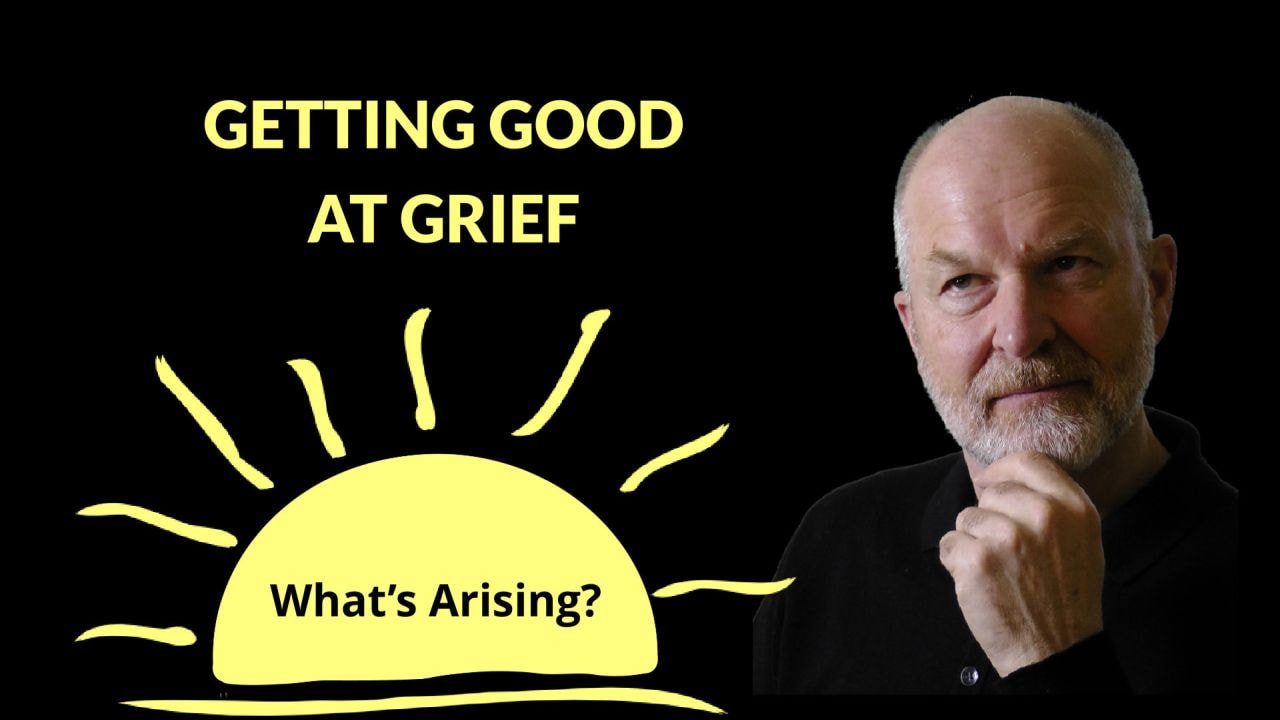
Getting Good at Grief: Learning to Feel, Release, and Still the Wave
...Episode 6 of the "What's Arising Podcast"
Any change, including positive change, can kick in a grief cycle because in order for the new to come in, something needs to be let go. Something is lost. With the rapid and accelerating change and disruption in our world today, in order to stay in balance and retain our sanity, we all need to get good at grief.
The challenge is that many people avoid or don't know how to deeply grieve, and let go of the past. The new cycles of grief, piled onto the heavy bags of unprocessed grief carried from the past can be so overwhelming that even little things can upset us. Upset is a 'set-up' or signal that we are sill holding onto something. Grieving, forgiving and surrendering are essential practices to move forward and navigate in these tumultuous times. Our well-being and survival depends on it.
Interested in getting good at grief and surrender?
Learn about Shadow Integration: https://www.wisdomways.net/shadowintegration/
Transcript
Welcome to What’s Arising?
In the last podcast, I talked about stilling the wave and about life as a wave of frequency — all of life moving as frequency, vibration, and energy.
So I am going to ring my bowl again, as I have done in several other podcasts, and I invite you to notice your own wave of life as I ring it three times.
Notice the inner wave: the vibration of being in your body, and all the energies moving through you.
Then notice the wave of humanity and what we are creating right now. If it is a fear wave, and there is certainly a lot of fear moving through the collective, simply notice that. If you like, send love to it.
Notice the wave of what we are creating as human beings.
And then notice the wave of all life, consciousness, and this experience of living, with its ups and downs.
Just be present with all that is.
[Music / Singing Bowl]
What I noticed as I rang the bowl was the fluttering of my eyes as I had them partially closed. A wave came through, almost like REM, as I settled into my body.
With each resonance of the bowl, I came into more reverence for life, more connection with life and all that is, and more compassion for what is happening in the world right now.
We are living through a very tumultuous time.
There is what is happening in Ukraine. There is what is happening in Israel and Palestine. There are also the many larger crises I have mentioned before: climate change, drug abuse, crime, economic instability, and many other things that can stir fear.
My sense is that some of this may get worse before it gets better. You can probably feel that if you spend time on the internet, in alternative news spaces, or in conversations within different communities.
There is a sense that many of the things we thought we knew, and many of the structures we thought were stable, may be heading for deeper disruption.
If you feel grief now, if you feel fear of loss now, if you feel anxiety now, the wave may get bigger.
I do not say that to scare you or create more anxiety. I say it as a way of naming what seems to be unfolding.
Hopefully, there are corrections coming. Hopefully, there are new possibilities emerging. But right now, a large wave of fear is upon us, and it is being amplified by media, world events, and the stories we are telling about the future.
There is a sense of impending destruction on the horizon.
The wave is getting bigger.
I was in a conversation the other day where someone said that in order to navigate these times, we need to get good at grief.
That phrase landed for me.
We need to get good at grief.
Because these are times of loss. Whether the loss is economic, physical, ecological, relational, or cultural, we are in a time of great change.
Every time we change, even when the change is good, something has to be let go. Something has to be surrendered in order to move through one period of life into the next.
There is always a letting-go period before something new can arrive.
We are in a great time of surrender.
A great time of letting go.
If we are to navigate this time as individuals and communities, we have to face our fears and release our fears.
We have to get good at grief.
Grief is a process of letting go.
When I think of grief, I often think of cultures where grief is expressed more fully — where there are wailing women, deep mourning, and a willingness to enter the grief all the way. That kind of grief dives deeply into the experience in order to transform it.
I think that is a powerful way to see grief.
Notice it. Let it arise. Dive deeply into it. Go right to the bottom of it.
Bring it on.
Let me cry.
I am a wailer, though mostly I do it alone. I have not yet learned how to do it fully in community, but I sense there is a beautiful place for grief in community — for wailing together, grieving together, and being witnessed together.
There is something beautiful about diving deeply into grief.
Because right on the other side of grief, in my experience, there is often a moment of joy. Or a moment of peace.
Whether the wave is anger, sadness, grief, or fear, if we dive fully into it, feel it all, watch it, and witness it, something shifts.
It can also be powerful to have others witness your grief. Grief in community can be healing. But at the very least, we can witness ourselves. We can feel it without getting completely lost in it.
When we dive into the grief and feel it fully, the vibration settles. By watching the vibration, we still the wave.
The grief may come back again, but usually not at the same intensity. Each wave that arises can be met in the same way:
Ah, here it is again.
Then we dive into the wave, feel it, and process it.
A small child can show us something about this. I have not had the fortune of having children, but I have had the fortune of watching children.
When a child is in a tantrum, or in a wave of anger or sadness, what happens if we simply hold them and allow the feeling? What if we say, “That’s all right. Feel that. I am here.” If we love them in their grief and allow them to process it, they may soon be playing again.
Very quickly, they can return to the joy of life.
But what do we often do to children instead?
“Don’t cry. Here’s a cookie.”
So they learn emotional eating.
Or we say, “If you don’t stop crying, I’ll give you something to cry about.”
And we stop the grief. We interrupt the process. We teach that grief is not good, crying is not good, and the lower waves of emotion are not acceptable.
We learn to cut off the wave rather than go to the bottom of it.
But whatever we do not process eventually comes back. The unprocessed grief creates disturbance in the body and emotional system. Almost anything can set it off.
It may come out as road rage, an outburst toward a spouse or partner, harshness toward children, conflict in community, or even hostility toward the world.
The grief comes out of the shadow as something destructive.
It does not have to be that way.
When we do have outbursts, we can take responsibility for the emotional wave arising inside us. We can be with it.
If we can be with it, we can shift it.
Many people hold on to grief. Perhaps we feel more alive when we hold on. Perhaps we believe that if we keep grieving, the person who passed, or the thing we lost, will stay alive in some way.
There can be something in the psyche that believes holding on to the past keeps us connected.
But my suggestion is to go deep into the grief.
Dive into it fully.
Do not resist it.
Jump into it.
Feel it.
Process it.
The deeper we can dive, and the more fully we can feel, the more complete the process can become.
And if we can do this together — if each of us can work with the waves inside us and then show up in the world as a more still wave — we may have a significant influence on what is happening in the collective.
If I add to the fear, the collective wave gets bigger.
If I attach myself to one side or the other of the drama, I push the wave higher.
But if each of us stills our own wave, we begin to relate differently to the collective.
This is the inner work.
It is also community work.
One of the wonderful things about conscious community is that our buttons will get pushed. We will notice our attachments. We will notice the waves we have stored away from earlier life experiences.
Those waves will come up in community.
And if the community is conscious, it can help hold the wave with us. It can support us as we feel, process, and release what is arising.
In that process, everyone in the community has the opportunity to still their own wave as well.
So if you would like support in stilling your wave, reach out.
You can have a discovery session with me, and we can talk about what is arising in your life and in your world. If we are the right partners to work together, we can explore a process to help you still your wave and step more fully into the joy and beauty of life.
The invitation is not to escape the waves, but to learn how to ride them — to move downstream with life rather than struggling against it.
If that calls to you, I would love to help.

Topics Explored
Shadow Integration • Wholeness • Freedom • Dialogue • Relationships • Personal Growth • Consciousness • Community • Leadership • Human Development • Individual & Collective Shadow Patterns • Beliefs

Pathways toward inner freedom and wholeness.


© WisdomWays. All rights reserved.