
What's Arising?
Blogs & Podcasts
Reflections, conversations, and explorations on the journey toward wholeness.
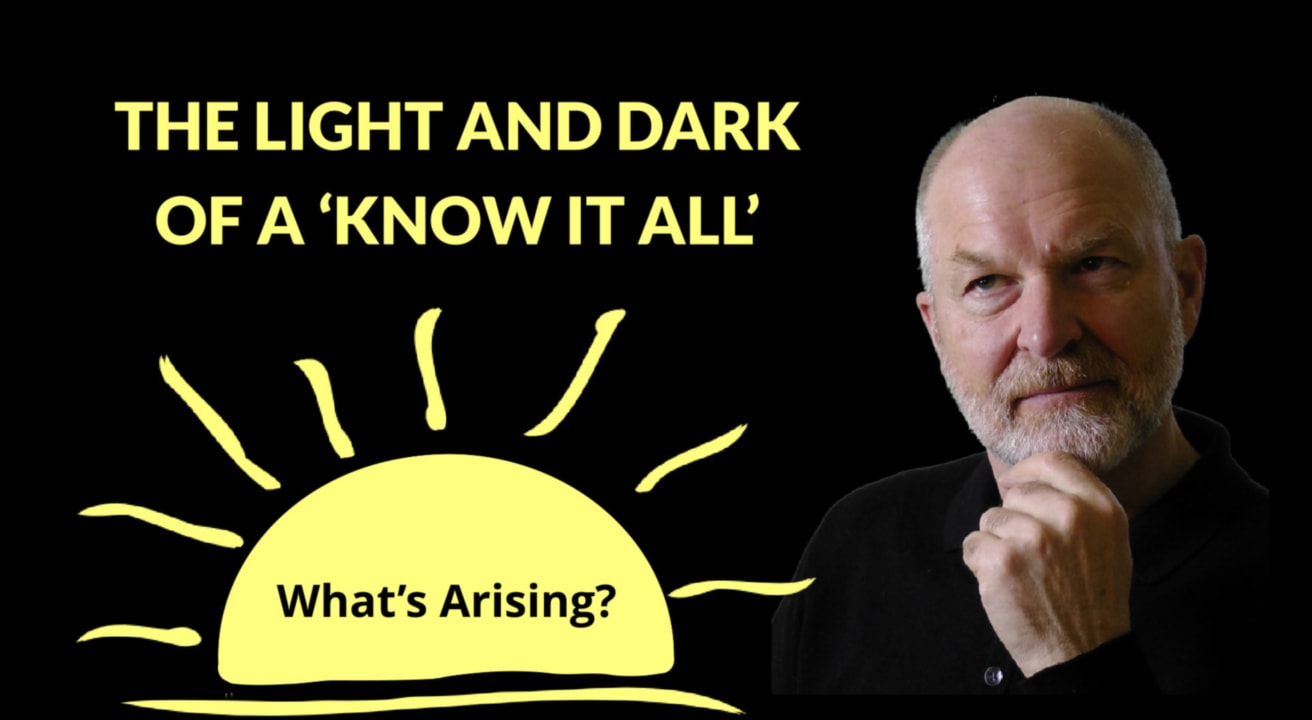
The Light & Dark of a "Know it All"
... Episode 16 of the What's Arising Podcast
We live in an amazing time when our access to vast knowledge and information is right at our fingertips and expanding at exponential rates, especially now with the emergence of AI. This has come with tremendous benefits for individuals and humanity, but is there a 'dark side'? Can the accumulation of knowledge be limiting our capacity to access wisdom and truth? In this podcast, I'll explore and contrast some of the light or positive aspects of accumulating knowledge, with the power and possibilities of letting go of what we think we know, embracing uncertainty and exploring our world with open inquiry and the wholeness of heart.
Links for items discussed in this podcast:
Subscribe, download, and listen to What's Arising on your favorite Podcast platform
Transcript
Welcome once again to What’s Arising?
In this episode, I want to talk about the light and dark of the “know-it-all,” or the impulse toward knowing it all.
What are the shadows around this culture of needing to know? What are the shadows around needing to have all the knowledge, all the answers, or all the certainty?
This is arising for me because of a few recent encounters with “know-it-alls.” And what I like to do, especially when I am triggered, frustrated, or taken out of myself, is bring the inquiry back to myself and my own journey.
So that is what I want to explore here.
I think there may be some interesting insights for both you and me as I move into this inquiry around the know-it-all.
Before I begin, I will ring my bowl again to help myself become present and to enter the energy of this podcast. I invite you to become present with it as well.
[Music / Singing Bowl]
We live in amazing times, don’t we?
There has been an explosion of knowledge and information in this so-called Information Age. There is a vast amount of information at our fingertips through our phones, computers, and the internet. We can ask Google almost any question and probably find an answer.
There is so much available now. So much being created in the realm of knowledge, information, data collection, and creativity. It has expanded our capacities in healthcare, economics, science, technology, and many other areas. Science has moved into realms that were once unknown. We have a growing understanding of the material world, and we also have more and more information available about the non-physical world.
And now, of course, we have arrived at the creation of AI systems, which will likely be another major expansion in terms of our ability to know things and find information.
In many ways, this has been amazing. It has been a good thing.
And yet, there are shadow sides to having all this information at our fingertips.
One of the things that tends to disturb me about this world of knowledge and information is that we have almost created a cult of experts. We put a lot of power, praise, and authority into the hands of those who are considered experts.
Expert knowledge is marketed to us. We are sold the “secret knowledge” to this or that. Education, training, and knowledge can be beautiful, but somehow, in the process, we may give away our empowerment, agency, responsibility, and inner authority to the experts.
Then, if the experts do not get it right, we can blame them. We can blame the models, the science, the authorities, or the systems.
There can be a kind of worship of knowledge, rather than a reverence for wisdom.
And those are different things.
In this Information Age and this culture of experts, knowledge is power. It can also become power over. People can have power over you if they have more knowledge, and you can have power over others if you know more than they do.
We have become accustomed to this.
Knowledge becomes linked to power, money, status, and influence. The more knowledge we have, the better job we may get. The more we know, the more we may be able to lead or tell others what to do.
That can feed our pride and self-importance. It can make other people seem lesser than us, or it can make us feel lesser than them. We may see others as smart and ourselves as stupid, or the other way around.
There is also this sense of secret knowledge. Someone says, “I have the secret knowledge, and I am going to reveal it to you.” We are enticed by the marketing of “the secret” of this and “the secret” of that. We crave being in the know. We want the knowledge, power, money, prestige, or formula that will give us an advantage.
At the same time, there is so much misinformation and disinformation being spread. It is hard to decipher what is true and what is not true. In our quest for knowledge and truth, there is manipulation, censorship, dogma, conditioning, and propaganda.
We start to become polarized into right/wrong thinking. We align ourselves around this information versus that information, this expert versus that expert, this worldview versus that worldview.
So this world of information is getting quite confusing.
And yet, again, it is also an amazing step in human evolution to have such access to information.
One of the challenges is that this kind of knowledge often satisfies the left brain. It is reductionist, material, mechanical knowledge. It tries to understand how things work through parts and pieces. It is a left-brain way of thinking.
I want to talk more about the right brain in a moment, but first I will share some of my own story around the know-it-all, and my own need to know.
I suspect I still have many aspects of that pattern to uncover, release, and soften. I am still learning to step more fully into the field of not knowing and curiosity.
When I was growing up, I had a fairly critical father. If you know the Enneagram, I used to test as a One — the type associated with the inner critic, fear of failure, fear of making mistakes, and the drive to be good or correct.
Because of that criticism, and because I wanted to make my father proud, I needed to know it all. I needed to be good enough. I needed to have the right answers.
In many ways, that worked well for me. I strived to have the answers. I got straight As in school. I received praise from teachers and others — not so much from my father, at least not directly. Perhaps behind the scenes he loved me, thought I was smart, and cared for me more than I knew, but I was not told that.
So I kept driving myself to get pride and acknowledgement from my father.
At the time, that shadow pattern worked for me in some ways. It came from a wound and a fear of failure, but it also led to good grades. I became the good boy. I went to university. I got a good job.
That was all based, in part, on what I knew.
And that was good for a time.
But at some point in our lives, the shadow that once worked for us begins to limit us. The wound that drove us to seek healing in the outer world eventually becomes a place where we get stuck. Life, or the soul, wants us to turn inward and examine the fear behind it. It wants us to heal the wound.
At some point in my career with IBM, I reached a place where knowing things no longer fulfilled me. Having the good job, having status, being seen as important because I knew things — it no longer felt satisfying.
As I look back, I can also see some of the challenges I had at that time. I was quite opinionated and judgmental of others. I could not stand people in my workplace who seemed incompetent.
Of course, that was a projection.
I feared incompetence in myself. I feared not knowing. I feared not having the answers.
This pattern limited my capacity to learn. To enter a true learning situation, especially one that is brand new, we need to be willing to not know. We need to be comfortable with our incompetence, because we have not yet been taught.
But I often felt disturbed if I did not already know something. I felt vulnerable because some part of me believed I should know things before I had even learned them.
It was insanity in many ways.
This made me close-minded in some areas. It was hollow and unfulfilling. And in that state, I was not answering the deeper inner questions that kept bubbling up, such as:
Who are you?
Luckily, there was another side of me that kept pestering me. There was an inner inquiry that would arise and say:
Find out who you are.
I also had a curiosity about the unknown. I loved Star Trek, and one of the themes that spoke to me was the invitation to go where no one had gone before.
If I had lived in the Middle Ages or during the Age of Exploration, I probably would have been on a ship traveling across the ocean to unknown lands, curious about what was out there.
There was an explorer and adventurer in me.
I came alive when I traveled, because I would let go of what I thought I knew and step into curiosity.
Even in university, although I studied some solid and practical subjects, I became interested in areas like genetics because there was so much that was not yet known. That intrigued me.
Only later did I realize that history, which I once thought of as factual and already known, was also a mystery. History is often written by the conquerors, and not always truthfully. So even there, I began to appreciate the mystery within it.
That innate curiosity of human beings has been driving our inquiry for ages. It has driven science, exploration, discovery, and expansion.
This explorer, this adventurer, this inquirer looking for answers, is a very positive part of the human psyche.
There is absolutely nothing wrong with it.
But if we remain only in a left-brain approach to knowledge, it can land us in closed boxes. It can lead to closed-mindedness and closed-heartedness. It can trap us inside a worldview that satisfies us because we think we now know.
We become the know-it-all within our field of influence.
Then we may become unwilling to open to other perspectives, viewpoints, or ideas. We can become polarized. We think we need to fix other people because they do not know what we know. We believe we need to teach them because they are wrong and we are right.
We know it all. They do not.
But humanity is like one organism with many cells. None of us holds all of the truth. We find more truth by opening to many different perspectives and learning to drop our assumptions, beliefs, and biases.
In the Information Age, we can easily go down rabbit holes that reinforce our existing biases and assumptions. These can lock us even more deeply into opinions and judgments about people outside our box.
We may follow our own cult of experts, become experts ourselves, and grow increasingly closed.
Science, in some ways, has also become closed and biased toward certain opinions and judgments. Yet at its base, science is meant to be open inquiry and exploration. It says, “For now, we know this. But what else? Do we know it all? Is there another theory?”
True science goes deeper and becomes more expansive.
Much of our world today has become very materialistic. So what about the spiritual side? Some scientists are more whole-brained, and their genius comes from first touching the whole — the right brain, the heart, the spiritual sense of life — and then bringing that into the left brain for analysis, sorting, pattern recognition, and organization. Then it returns again to the wholeness of the right brain, where the world can be seen in a new way.
This sense of curiosity, inquiry, and stepping into the mystery of life is extremely important.
Who am I?
Who are we?
What becomes possible when we let go of what we think we know?
What becomes possible when we release conditioning, forgive ourselves for our mistakes and fears, and open our hearts and minds?
We are invited to move beyond getting stuck in our old worldview and our old problems.
Part of this reflection came from some recent encounters that disturbed me. I met people who seemed to come from a know-it-all perspective — just as I suppose I have done in the past, and probably still do at times.
When I get into those situations, I can become frustrated because I want to explore and dialogue. I want to inquire into what is real in the situation.
But sometimes, when I begin speaking about something, I get interrupted. An assumption is made, and suddenly the other person is telling me what they know before they have even listened.
In my world, more and more over the last few years, I have come to deeply appreciate the capacity to dialogue. I appreciate opening our hearts and minds, sitting together, dropping assumptions, and listening deeply.
That has been a journey for me.
I have also been learning to speak and listen from the inner voice, allowing myself to say something when I am called to speak from deeper knowing.
Instead of coming only from information, we can come from intuition, inspiration, and insight.
I think there is much more possibility when we let go of what we think we know — our conditioning, dogma, beliefs, and assumptions — and come from curiosity, intuition, and insight.
If we are going to solve the world’s problems, many of which were created through left-brain knowledge and certainty, we may need to step into curiosity and invite insight.
That may lead to a greater expansion.
In many ways, this has been our journey all along: returning to the energy of the child. Returning to curiosity.
When we come from this childlike energy and remain open to the unfolding, life becomes more creative and playful. I notice more synchronicity. I am surprised and delighted by what shows up when I am open, rather than moving through the world with blinders on.
It is much more enlivening to be curious about others than to remain stuck in my own worldview, trying to change them, or having them try to change me.
There is a verse in Matthew 18:3 that says, unless you change and become like little children, you will never enter the kingdom of heaven.
To me, that speaks to this childlike energy of play, curiosity, open heart, and open mind. It is a wide-open place of learning, exploration, adventure, and receptivity. It allows insight to drop in.
There is so much possibility when we connect to that child energy.
As adults, we have the opportunity to reconnect with that childlike openness and then move into a deeper exploration of truth — a truth that is held more in the right brain, in wholeness, rather than only in parts and pieces.
I believe humanity is going through a great shift from left-brain thinking to whole-brain thinking. This includes incorporating the right brain and allowing it to lead, while the left brain supports.
It is a movement from the feminine energy, the open and insightful energy, into the masculine, with the masculine following and supporting the feminine. This is different from what has often happened for thousands of years.
We are moving into an age of insight, imagination, innovation, and inspiration. This requires letting go of what we think we know and becoming more comfortable with uncertainty.
Like a child, we are invited to have the courage to jump into the experience that is showing up in the moment.
I think our genius is in the power of formulating good questions.
When we ask truly open-ended and powerful questions, we invite the universe, spirit, intuition, God — however we understand that realm — to answer our questions and bring in genius.
Perhaps AI, in its positive expression, can be part of this great shift.
If so many of the things the left brain wants to know can now be answered at our fingertips, perhaps we will not need to use our left brain as much to figure everything out. Maybe that frees us to ask more powerful questions.
Maybe we can shift toward the inner quest for knowledge, toward the bigger questions of the universe, rather than focusing only on figuring out the mechanical or material world.
We can ask questions of spirit. We can enter deeper inquiry with each other. We can come into coherence.
This requires dropping the busyness of the left-brain mind and the ego’s need to know. It asks us to drop the self-importance of ego and come into presence, being, and a deeper field of knowing.
There is a kind of knowing that is not based on facts, data, or information. It is pure knowing. A right-brain knowing. An intuitive knowing. Perhaps even a kind of omniscience.
That is my hope and my prayer.
I hope this exploration is useful to your own inquiry.
I invite you to look at your own journey around knowing and not knowing. Around being smart enough. Around rebellion against experts. Around infatuation with people who seem to know things. Around disturbance toward people who appear too certain.
Look at your relationship to knowing, not knowing, not knowing enough, or not being good enough.
Many of these things, especially when they carry an emotional charge, may be shadows. They may be projections of something within ourselves.
By turning that around and going inside, or by opening that inquiry with others who can sit with us and not simply tell us the answers, we can enter the unknown together. In that place, there is so much expansion available.
Thank you for listening.
If you want to join me in inquiry into shadow, into letting go of what you know, or suspending what you think you know — your assumptions, beliefs, and certainties — there are a few ways you can do that.
On a personal basis, you can work with me through coaching, mentoring, or Shadow Discovery sessions. Together, we can inquire into what disturbs you, where there is a charge, and see what gets revealed.
This is more about process than advice. It is not about me telling you what to do. It is about opening to that childlike energy and stepping into curiosity, so that what needs to be known can reveal itself.
Another opportunity is through the dialogues you will find on the WisdomWays site. Together, we inquire into these themes in Insight Cafes, Leadership Cafes, and other dialogue spaces.
All the best in what is arising in and through you.
Take care.

Topics Explored
Shadow Integration • Wholeness • Freedom • Dialogue • Relationships • Personal Growth • Consciousness • Community • Leadership • Human Development • Individual & Collective Shadow Patterns • Beliefs
Pathways toward inner freedom and wholeness.


© WisdomWays. All rights reserved.